
What is the 4+2 Growth Matrix?
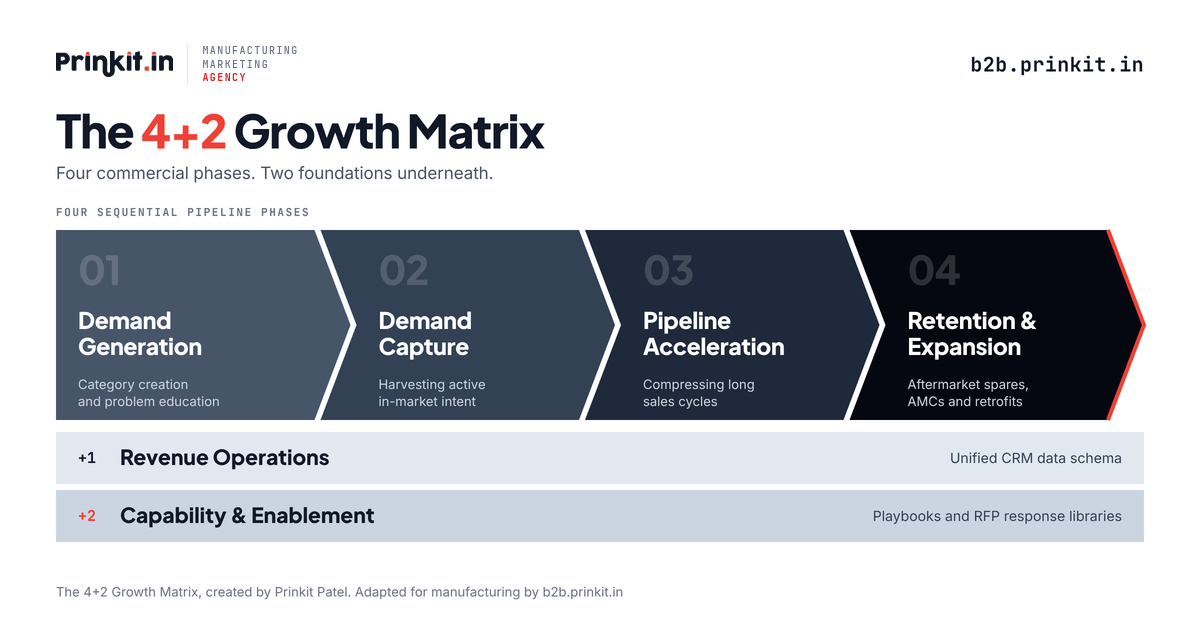
The 4+2 Growth Matrix is an enterprise B2B growth framework created by Prinkit Patel for high-ticket, sales-led organisations outside SaaS. It sorts every growth initiative into four sequential pipeline phases (Demand Generation, Demand Capture, Pipeline Acceleration, and Retention & Expansion) plus two cross-cutting foundations: Revenue Operations (RevOps) and Capability & Enablement.
We have adapted it for Indian capital equipment manufacturers with long, multi-month sales cycles. You may also see it written as the four plus two growth matrix or the 4 plus 2 growth framework; it is the same model. Because it was built for large deals decided by buying committees rather than self-serve sign-ups, it works as a non-SaaS B2B growth framework. It is distinct from the 4+2 Formula (Nohria, Joyce and Roberson) and from the BCG matrix and the Ansoff matrix.
The framework and our adaptation
The 4+2 Growth Matrix, created by Prinkit Patel for high-ticket, sales-led enterprise B2B organisations outside SaaS. The general framework gives these organisations one Mutually Exclusive and Collectively Exhaustive (MECE) structure for every growth initiative: four pipeline phases, each with a primary owner, and two foundations shared by every phase.
Adapted for Indian manufacturers by b2b.prinkit.in. We keep the six component names and apply them to capital-goods and engineered-to-order businesses, where plant capacity utilisation governs the economics. Everything below this section describes our adaptation. For a shorter walk-through, read our article The 4+2 Growth Matrix: from high-ticket B2B to Indian manufacturing.

Download: The 4+2 Growth Matrix guide (PDF, 2 pages) · diagram (PNG)
How is the 4+2 Growth Matrix different from the 4+2 Formula and the Ansoff Matrix?
They answer different questions. The 4+2 Formula describes the management practices its authors linked to sustained company performance. The Ansoff Matrix sets out product and market options for growth. The 4+2 Growth Matrix organises commercial growth initiatives into four sequential pipeline phases and two cross-cutting foundations.
The 4+2 Formula (Nohria, Joyce and Roberson)
Nitin Nohria, William Joyce and Bruce Roberson set out the 4+2 formula in “What Really Works”, published in Harvard Business Review in July 2003 [1]. Their research, the Evergreen Project, examined more than 200 management practices as employed by 160 companies over ten years, from 1986 to 1996 [1, 2]. They found that companies which outperformed their industry peers excelled at four primary management practices (strategy, execution, culture and structure) and mastered any two of four secondary practices (talent, innovation, leadership, and mergers and partnerships) [2].
The Ansoff Matrix
H. Igor Ansoff described four basic growth alternatives in “Strategies for Diversification”, published in Harvard Business Review in 1957: market penetration, market development, product development and diversification [3, 4]. The matrix named after him sets existing or new products against existing or new markets [4].
Where the 4+2 Growth Matrix differs
The 4+2 Growth Matrix does not rate management practices, and it does not choose between product and market options. It sorts the commercial work of winning and keeping customers into four sequential pipeline phases (Demand Generation, Demand Capture, Pipeline Acceleration, and Retention & Expansion) and two cross-cutting foundations (Revenue Operations and Capability & Enablement). The names share “4+2”; the models do not.
The 4+2 Growth Matrix, created by Prinkit Patel. Adapted for manufacturing by b2b.prinkit.in.
Sources: [1] N. Nohria, W. Joyce and B. Roberson, “What Really Works”, Harvard Business Review, July 2003. [2] Harvard Business School Working Knowledge, “4+2 = Sustained Business Success”. [3] Igor Ansoff, “Strategies for Diversification”, Harvard Business Review, 1957 (archived copy). [4] Wikipedia, “Ansoff matrix”.
The 4+2 Growth Matrix establishes a rigorous, Mutually Exclusive and Collectively Exhaustive (MECE) commercial operating system for capital equipment manufacturers facing long, multi-month sales cycles. It organises every growth initiative into four sequential pipeline phases—Demand Generation, Demand Capture, Pipeline Acceleration, and Retention & Expansion—anchored by two cross-cutting enablement foundations: Revenue Operations (RevOps) and Capability & Enablement.
The Factory Floor Reality: The Unforgiving Math of Machine Bay Utilisation
In heavy engineering and machinery manufacturing, the financial health of the business is governed by an unforgiving physical reality: Plant Capacity Utilisation.
Whether your plant manufactures API 610 industrial process pumps, 765kV power transformers, ASME Section VIII pressure vessels, or specialised CNC automation lines, heavy fixed costs run 24 hours a day:
- Heavy capital investments in fabrication bays, overhead crane infrastructure, CNC boring machines, and testing facilities.
- Continuous bank interest and depreciation servicing on multi-crore term loans.
- Retaining specialised design engineers, ASME-certified welders, and technical estimation teams.
When plant utilisation slips, unabsorbed fixed overheads rapidly wipe out EBITDA. Promoters face a structural vulnerability: word-of-mouth reaches an organic plateau, public tenders force devastating L1 price cuts, and multi-crore quotation files freeze indefinitely inside client review boards.
For example (illustrative): for a ₹100 Crore rated capacity machinery plant operating at 65% utilisation, carrying costs of unabsorbed overhead can run to ₹35 Lakhs to ₹45 Lakhs every single month. Test your exact plant parameters using our live Interactive Capacity Simulator →
The 4+2 Growth Matrix Architecture
To break this vulnerability, the 4+2 Growth Matrix provides an end-to-end commercial architecture. Below is an interactive visual blueprint mapping the four sequential pipeline phases and two cross-cutting enablement foundations.
Module 1: Demand Generation (Phase 1)
Primary Commercial Intent: Category creation, engineering problem education, brand salience, and unprompted recall among target industrial accounts and project engineering consultants before an active buying cycle or public RFP begins.
In heavy engineering, deals are virtually decided during the Front-End Engineering Design (FEED) stage. If an EPC consultant standardises on a competitor’s metallurgy or dimension tolerances in the project’s Basic Engineering Design Package (BEDP), you are forced to fight an uphill L1 tender battle. Phase 1 embeds your technical authority into the engineering ecosystem early.
Algorithmic & Generative AI Discovery
Engineering your digital presence so search engines and generative AI models recommend your plant when C-suite buyers prompt technical queries.
- B2B Pillar SEO & Topical Authority: Authoritative pillar-cluster architectures targeting macro engineering standards (e.g. ASME Section VIII Div 2, API 610, IS 2026) rather than superficial vanity keywords.
- Answer Engine Optimisation (AEO): Engineering schema markup, technical specification tables, and direct definitional answers optimised for extraction by Google AI Overviews and Perplexity.
- Generative Engine Optimisation (GEO): Seeding digital citations, research papers, and technical whitepapers into LLM training corpora so generative platforms cite your firm when users ask: "Who are the qualified API 610 pump manufacturers in India?"
Proprietary Media & Category Thought Leadership
Establishing the manufacturer's leadership as authoritative industry practitioners solving complex manufacturing bottlenecks.
- Executive POV & Leadership-Led Social Media: Positioning the Managing Director and Chief Technology Officer on LinkedIn with deep, contrarian viewpoints on metallurgy, plant reliability, and capex optimisation.
- Annual State-of-the-Industry Benchmark Reports: Publishing original quantitative research surveying a broad panel of enterprise Plant Heads on equipment downtime and efficiency metrics.
- B2B Technical Video & Podcast Series: In-depth engineering interviews with respected sector consultants and chief engineers, creating an industry-wide media asset.
- C-Suite Industrial Intelligence Briefing: A monthly technical bulletin breaking down regulatory shifts, raw material indices (CRGO steel, nickel alloys), and CAPEX outlooks.
Targeted Cold Account Advertising & Paid Air-Cover
Precision air-cover keeping your engineering capabilities visible to pre-selected enterprise dream accounts.
- Account-Matched LinkedIn Ads: Serving technical case briefs to buying-committee roles at a pre-selected list of top private capex accounts.
- LinkedIn Thought Leader Ads to Buying Groups: Sponsoring organic technical posts directly to Plant Heads, CPOs, and Project Directors within targeted account lists.
- Niche Industrial Journal Sponsorships: High-impact placements in recognised technical publications (Chemical Industry Digest, IEEMA Journal, EPC World).
Third-Party Authority & Ecosystem Positioning
Systematic engagement with engineering consultants and third-party inspection authorities to institutionalise category trust.
- Consultant Briefing Programmes: Dedicated technical presentations to the engineering consultancies that specify your equipment.
- Strategic Industrial PR & Technical Op-Eds: Placing signed technical articles in tier-1 business and trade press on manufacturing indigenisation and energy transition.
- Non-Competing OEM Alliances: Joint technical webinars and educational papers with complementary industrial software and automation vendors.
Community Cultivation & Educational Summits
Hosting peer-level environments that bring industrial decision-makers together without commercial pitch pressure.
- Private C-Suite Industrial Roundtables: Closed-door, Chatham House Rule dinners for small groups of Plant Directors discussing decarbonisation and supply chain resilience.
- Virtual Engineering Masterclasses: Deep-dive webinars demonstrating finite element analysis (FEA), computational fluid dynamics (CFD), and life-extension frameworks.
Module 2: Demand Capture (Phase 2)
Primary Commercial Intent: Intercepting existing, active in-market capex intent, parameter-gating enquiries to eliminate directory scrap brokers, and converting qualified engineering buyers into proprietary pipeline opportunities.
When an enterprise plant team receives capex sanction, they do not casually browse directories. They search with exact duty specifications and code standards. Phase 2 ensures you capture these high-value buyers with frictionless, technically credible digital entry paths.
High-Intent Inbound Paid Search
Capturing active buyers searching for exact industrial solutions and technical replacements.
- Transactional Search Advertising: Bidding exclusively on high-commercial-intent, parameter-specific keywords (e.g. "Class 300 duplex stainless steel reactor fabricator", "33kV GIS switchgear supplier Gujarat").
- Negative Keyword Gating: Rigorously eliminating low-ticket consumer and hobbyist keywords (e.g. "used", "mini", "cheap", "diy", "repair video").
- Multi-Tiered Technical Retargeting: Showing FAT video test documentation and ASME certificates to visitors who inspected equipment data sheets without submitting a bid request.
High-Value Conversion Offers (HVCO) & Sizing Tools
Replacing generic "Contact Us" forms with interactive engineering calculators that capture detailed operating parameters.
- Interactive Sizing & Capacity Calculators: Web apps where plant engineers enter head, flow, operating temperature, or tonnage to receive preliminary equipment sizing.
- TCO & Lifecycle Payback Models: Financial simulators comparing the 20-year energy consumption of high-efficiency designs versus standard machinery.
- Standardised RFP & Specification Templates: Pre-engineered, editable technical specification matrices that procurement teams can adopt directly for their bidding dossiers.
Conversion Path & Landing Architecture (CRO)
Eliminating conversion friction on technical equipment pages and routing genuine buyers directly to senior sales engineers.
- Specification-Grade Solution Pages: Equipment pages equipped with downloadable general arrangement (GA) drawings, performance curves, and metallurgy matrices.
- Direct Engineering Consultation Scheduling: Instant calendar booking with senior application engineers for qualified enterprise enquiries.
- Technical Parameter Qualification Gates: Requiring duty condition inputs before quotation submission, filtering out non-serious brokers automatically.
Targeted Commercial Field Marketing & Exhibitions
Transforming expensive industrial trade show booths from passive brochure distribution into high-yield commercial meeting suites.
- Pre-Booked Executive Meeting Suites: Scheduling confidential meetings with pre-identified project heads weeks before the exhibition opens.
- Exclusive VIP Breakfast Briefings: Hosting private breakfast discussions for key buying committees on the sidelines of flagship exhibitions (e.g. Chemtech, ELECRAMA, IMTEX).
Module 3: Pipeline Acceleration (Phase 3)
Primary Commercial Intent: Compressing long, multi-month sales cycles, multi-threading the enterprise buying committee (Plant Head, CFO, CPO, Safety Director), eliminating proposal stalls, and defending engineering margins against L1 price compression.
The single largest point of failure in capital equipment commercial operations occurs after the quotation has been submitted. The technical team approves the machinery, but the multi-crore bid can then sit in commercial review for months. Phase 3 arms your internal champion to push the deal through the executive committee.
1:1 & 1:Few Deal-Stage Account-Based Marketing (ABM)
Targeted digital air-cover and bespoke presentation environments dedicated to active high-ticket opportunities.
- Stage-Triggered Deal-Stage Advertising: The moment a proposal exceeds ₹2 Crore, ads targeting the client's board switch to compliance certifications, plant uptime proofs, and risk elimination.
- Bespoke Digital Sales Rooms (DSRs): Replacing bulky PDF email attachments with private, interactive web portals housing customised techno-commercial bids, FAT video walkthroughs, and financial payback models in one secure link.
- Proposal Page Engagement: Showing sales engineers when the buyer's private proposal page, including pricing and warranty clauses, is opened and shared.
Buying Committee Multi-Threading Kits & Toolkits
Equipping internal champions with role-specific collateral tailored to every member of the buying committee.
- Role-Specific Impact Briefs: Two-page executive briefs tailored to individual committee priorities:
- For the CFO: Cash flow impact, milestone schedules, depreciation schedules, and energy payback.
- For the CPO: Delivery penalty commitments, warranty terms, and genuine spare price locks.
- For the Plant Head: MTBF data, mean time to repair (MTTR), and ease of routine maintenance.
- Champion Board Approval Decks: Pre-formatted executive slide decks designed for your technical champion to present to their managing board for capex sign-off.
- Head-to-Head Technical Battlecards: Rigorous, objective comparison matrices breaking down metallurgical advantages, weld quality, and operating efficiencies over low-cost competitors.
High-Touch Relational & Executive Engagement
Peer-to-peer executive alignment that removes commercial friction and de-risks multi-crore commitments.
- Promoter-to-Promoter Sponsorship: Strategic alignment sessions between your Managing Director and the client’s executive leadership.
- On-Site Technical Blueprint Labs: Immersive half-day co-design workshops at the prospect's corporate headquarters to finalise plant layout integrations.
- Peer-to-Peer Reference Engagements: Private dinners connecting a hesitating prospect’s Plant Head with a respected industry peer currently operating your equipment.
Automated Deal Nurturing & Pipeline Reanimation
Systematically re-engaging proposals that have stalled in client committees or were previously postponed.
- Stage-Specific Technical Follow-Up Sequences: Educational follow-up emails triggered automatically if a proposal sits in commercial review for >21 days.
- Stalled Proposal Reanimation Triggers: Structured re-engagement when an annual shutdown approaches, or when a competitor's delayed delivery creates capex vulnerability.
- Closed-Lost Win-Back Reviews: Post-mortem analyses identifying why an order was lost, re-entering the account later as warranty periods expire.
Module 4: Retention & Expansion (Phase 4)
Primary Commercial Intent: Compounding Customer Lifetime Value (LTV), protecting high-margin aftermarket spares and service contracts, and systematically expanding into new plant units across the client's corporate group.
In heavy machinery, the initial equipment sale is only the beginning of profitability. Genuine replacement parts, wear components, overhaul services, and annual maintenance contracts (AMCs) deliver superior operating margins. Phase 4 institutionalises installed base farming before local unauthorised fabricators capture that revenue.
Onboarding Excellence & Time-to-Value (TTFV)
Ensuring flawless delivery, commissioning, and handover that cements client trust for future capex waves.
- Dedicated Client Commissioning Portals: Digital hubs tracking dispatch milestones, foundation readiness checklists, and FAT certificates.
- 30-60-90 Day Performance Milestone Audits: Formal engineering reviews presented to the client's leadership verifying that the machinery is achieving rated throughput and efficiency.
Installed Base Farming & White-Space Expansion
Auditing historical machine shipments going back many years to identify expansion opportunities across sister plants.
- Historical Installed Base Audits: Mapping every machine serial number deployed across industrial clusters to forecast refurbishment and replacement cycles.
- Multi-Plant Subsidiary Expansion: Leveraging success in one manufacturing unit to secure direct sole-source vendor registration across the conglomerate's other divisions.
- Targeted Expansion Air-Cover: Running focused LinkedIn campaigns showcasing plant reliability to plant directors at the client's other locations.
Strategic Governance & Multi-Year AMCs
Transforming transactional maintenance into predictable, recurring service contract revenue.
- Executive Business Reviews (EBRs): Bi-annual strategic meetings with the client's VP of Manufacturing presenting uptime analytics, energy savings, and preventative maintenance schedules.
- Comprehensive AMC Packaging: Structured annual service tiers guaranteeing technician dispatch SLAs and genuine spare availability to lock out third-party suppliers.
Documentary Social Proof & Advocacy Engine
Turning satisfied clients into high-credibility proof assets that feed Phase 1 demand generation.
- Documentary Video Case Studies: On-site video documentation showing the installed machinery running in live production, featuring the client Plant Head discussing uptime and savings.
- Joint Industry Technical Papers: Co-authoring technical papers with client engineering leads presented at national industrial conventions.
Module +1: Revenue Operations
Primary Commercial Intent: Delivering the unified quotation tracking, lead data synchronisation, sales routing SLAs, and multi-touch pipeline attribution that allow all commercial phases to operate without data leaks or software bloat.
Too many manufacturing enterprises purchase expensive CRM software that sales engineers abandon because it requires excessive manual data entry. We advocate a stack-agnostic, zero-software-tax RevOps model that integrates with the tools your team already relies on.
Commercial Tech Stack & Quotation Architecture
Building clean, lean commercial pipelines mapped to actual industrial manufacturing milestones.
- Technical Pipeline Milestone Schema: Stages structured by engineering reality (FEED Consultation → Pre-Qualification / AVL → Techno-Commercial Bid → Buying Board Review → Final Negotiation → PO Issued).
- Zero-Data-Loss Form Webhooks: Ensuring technical parameter form submissions from web calculators route immediately into sales dashboards without manual re-entry.
Data Governance, Enrichment & Lead Scoring
Enriching raw enquiries with corporate hierarchy data to prioritise multi-crore capex buyers.
- Automated Firmographic Enrichment: Appending plant turnover, employee counts, and operating sites to incoming enquiry domains.
- Lead Scoring: Agreed CRM rules that rank enquiries by fit, enquiry details and website activity, alerting sales reps when an account is in an active capex cycle.
Routing SLAs, Territory Assignment & Speed-to-Lead
Eliminating quotation delays by establishing strict routing protocols based on machinery category and geographic territory.
- Automated Territory & Product Routing: Directing pressure vessel enquiries to specialised process engineers and pump enquiries to rotating equipment specialists instantly.
- Speed-to-Lead Escalation Alerts: Automated SMS and messaging notifications if a high-intent technical brief remains unacknowledged for >4 hours.
Attribution, Velocity Cohorts & Forecasting Clarity
Providing the Managing Director transparent visibility into pipeline velocity and true marketing ROI.
- Multi-Touch Commercial Attribution: Tracking how an initial consultant spec-in article in Phase 1 influenced a closed order many months later in Phase 3.
- Funnel Velocity Cohort Tracking: Identifying exact stages where multi-crore quotations stall, enabling targeted sales intervention.
Module +2: Capability & Enablement
Primary Commercial Intent: Upskilling technical commercial talent, codifying sales methodologies, aligning marketing and sales cultures, and replacing generic marketing brochures with verifiable shop-floor proof (FAT/PWHT/Hydrostatic tests).
Industrial buyers are deeply sceptical of polished marketing brochures filled with generic stock photos. High-ticket capital equipment buyers require verifiable engineering proof: certified weld logs, video recordings of Factory Acceptance Tests, and rigorous qualification frameworks.
Commercial Alignment & Joint Revenue Council
Ending the traditional divide between marketing and engineering sales teams.
- Weekly Joint Revenue Council: Mandatory weekly review between the Managing Director, Head of Marketing, and Regional Sales Heads to evaluate open quotes and pipeline velocity.
- Commercial Field Immersion: Marketing strategists attend customer technical review meetings monthly, ensuring marketing materials reflect real shop-floor customer objections.
Sales Methodology Codification (MEDDPICC)
Standardising deal qualification so sales engineers don't waste weeks estimating bids where the company has no chance of winning.
- Industrial Qualification Playbooks: Codifying MEDDPICC (Metrics, Economic Buyer, Decision Criteria, Decision Process, Paper Process, Identify Pain, Champion, Competition) into the technical estimation workflow.
- Buying Group Multi-Threading Playbooks: Concrete guidelines for sales reps to expand beyond a single plant contact to engage finance, procurement, and operations leads.
Centralised Collateral & Modular RFP Library
Empowering sales engineers with pre-approved technical documentation to turn around bids much faster.
- Dynamic Asset Repositories: Centralised digital library organised strictly by machinery type, industry sector, and buyer persona.
- Modular Pre-Approved RFP Library: Curated repository of quality certificates, testing standards, safety compliance, and standard legal clauses that cut proposal preparation time.
Skills Development & Shop-Floor Verifiable Proof
Transforming factory capabilities into insurmountable competitive moats.
- Shop-Floor Verifiable Video Documentation: High-definition video proof of hydrostatic testing, dynamic balancing, clean-room assembly, and radiographic weld inspections.
- Consultative Boardroom Presentation Workshops: Training technical sales engineers to present financial ROI and risk elimination to client executive boards with confidence.
The Master MECE Matrix: Complete Initiative Catalogue
Cross-functional overview mapping all 25 sub-pillars to primary ownership, commercial intent, illustrative initiatives, and success metrics.
| Module | Sub-Pillar | Core Commercial Intent | Primary Owner | Key Metric |
|---|---|---|---|---|
| Phase 1: Demand Generation | 1.1 Algorithmic & AI Discovery | Topical authority across ASME/API specs, AEO and GEO engine recommendations. | Search Visibility & Citations | |
| Phase 1: Demand Generation | 1.2 Proprietary Media | Establish market POV through MD thought leadership and benchmark reports. | C-Suite Brand Salience | |
| Phase 1: Demand Generation | 1.3 Cold Target Air-Cover | Account-matched LinkedIn ads and thought leader ads to buying groups. | Cost per Engaged Account | |
| Phase 1: Demand Generation | 1.4 Third-Party Authority | Engineering consultant spec-in (EIL, Toyo, Technip) and industrial PR. | Approved Vendor List (AVL) Wins | |
| Phase 1: Demand Generation | 1.5 Community Cultivation | Private C-suite industrial roundtables and non-commercial technical masterclasses. | Target Account Attendance | |
| Phase 2: Demand Capture | 2.1 Inbound Paid Search | Capture active in-market capex intent using negative-keyword gating. | Cost per Qualified SQL | |
| Phase 2: Demand Capture | 2.2 High-Value Offers (HVCO) | Interactive sizing calculators, TCO payback tools, and editable RFP templates. | Technical Form Conversion % | |
| Phase 2: Demand Capture | 2.3 Conversion Path (CRO) | Specification-grade product pages with direct engineering calendar scheduling. | Booking Rate & MQL-to-SQL | |
| Phase 2: Demand Capture | 2.4 Field & Trade Marketing | Pre-booked executive meeting suites and VIP breakfast sessions at expos. | In-Person Sourced Pipeline | |
| Phase 3: Pipeline Acceleration | 3.1 Deal-Stage ABM & DSRs | Private digital sales rooms and proposal page engagement for multi-crore bids. | Pipeline Velocity (Days to Close) | |
| Phase 3: Pipeline Acceleration | 3.2 Buying Committee Kits | Role-specific briefs (CFO financial ROI, CPO delivery guarantees, Plant Head MTBF). | Committee Multi-Threading Index | |
| Phase 3: Pipeline Acceleration | 3.3 High-Touch Engagement | MD-to-MD executive sponsorship, on-site blueprint labs, peer references. | Stalled Proposal Close Rate | |
| Phase 3: Pipeline Acceleration | 3.4 Deal Nurturing | Automated CRM follow-up sequences and closed-lost proposal reanimation. | Stalled Pipeline Recovery % | |
| Phase 4: Retention & Expansion | 4.1 Onboarding Excellence | Customer implementation hubs and 30-60-90 day value milestone audits. | Time-to-Value & Commissioning CSAT | |
| Phase 4: Retention & Expansion | 4.2 Account Expansion | Historical installed base audits and multi-plant sister subsidiary expansion. | Expansion Revenue & Spares % | |
| Phase 4: Retention & Expansion | 4.3 Strategic Governance | Executive Business Reviews (EBRs) and comprehensive multi-year AMC packages. | Net Revenue Retention (NRR) | |
| Phase 4: Retention & Expansion | 4.4 Social Proof & Advocacy | Documentary on-site video case studies and joint technical convention papers. | Advocacy Yield & Inbound Proof | |
| +1 Revenue Operations | 5.1 Stack Architecture | CRM schema mapped to manufacturing milestones with zero software tax. | System Data Uptime & Hygiene | |
| +1 Revenue Operations | 5.2 Data Hygiene & Lead Scoring | Automated firmographic enrichment and CRM lead scoring on enquiries. | Target Account Coverage % | |
| +1 Revenue Operations | 5.3 Routing & SLAs | Lead-to-account matching and instant territory/specialist routing. | Speed-to-Lead Response Time | |
| +1 Revenue Operations | 5.4 Analytics & Attribution | Closed-loop multi-touch attribution and stage velocity cohort tracking. | Forecast Accuracy & Pipeline ROI | |
| +2 Capability & Enablement | 6.1 Commercial Alignment | Joint Revenue Council governance and cross-functional field immersion. | Revenue Council SLA Adherence | |
| +2 Capability & Enablement | 6.2 Sales Methodologies | MEDDPICC enterprise qualification playbooks and multi-threading guides. | Rep Quota Attainment % | |
| +2 Capability & Enablement | 6.3 Collateral Management | Dynamic content repository and modular pre-approved RFP response library. | Content Utilisation Rate | |
| +2 Capability & Enablement | 6.4 Skills & Testing Proof | Shop-floor video documentation (FAT/PWHT) and consultative boardroom training. | Technical Audit Approval Speed |
How do you implement the 4+2 Growth Matrix?
Not as a checklist of all 25 initiatives at once. Diagnose where quotations stall, weight the 4+2 phases by your plant’s utilisation bottlenecks, select two or three focused plays that attack the friction point, and check that the RevOps routing (+1) and engineering test documentation (+2) are ready to support them.
For a Managing Director, Commercial Director, or VP of Sales, this taxonomy should not be treated as a rigid checklist where all 25 initiatives are attempted simultaneously. It is an initiative menu applied through a disciplined, 4-step diagnostic process:
Audit where quotation velocity stalls: lack of pre-RFP pipeline, low form conversion, or proposals freezing in client committees.
Allocate leadership bandwidth and capital across the 4+2 phases based on your plant’s utilisation bottlenecks.
Deploy targeted high-leverage initiatives (e.g. DSRs in Phase 3 or FEED spec-in in Phase 1) directly attacking the friction point.
Ensure the underlying RevOps routing (+1) and engineering testing documentation (+2) are ready to support execution.
• If your factory machine bays lack pipeline 2–3 quarters out → Overweight Phase 1 (Pre-Tender Spec-In).
• If website traffic exists but sales reps only receive low-ticket broker enquiries → Overweight Phase 2 (Demand Capture & Sizing Tools).
• If multi-crore quotations stall in client review boards for >90 days → Overweight Phase 3 (Pipeline Acceleration & DSRs).
• If high-margin spares leak to local fabricators → Overweight Phase 4 (Retention & Expansion).
Free Manufacturing Growth Diagnostic
A 45-minute call with a senior b2b.prinkit.in consultant, then a written report within 3 business days of the call. It's free, there's no obligation, and the report is yours to use whether or not you work with us.
Book Your Free Diagnostic →Frequently Asked Questions
Who created the 4+2 Growth Matrix?
Prinkit Patel created the 4+2 Growth Matrix for high-ticket, sales-led enterprise B2B organisations outside SaaS. The version on this page is adapted for Indian manufacturers by b2b.prinkit.in.
Is the 4+2 Growth Matrix the same as the 4+2 Formula, the BCG matrix or the Ansoff matrix?
No. The 4+2 Growth Matrix is distinct from the 4+2 Formula (Nohria, Joyce and Roberson) and from the BCG matrix and the Ansoff matrix. It sorts commercial growth initiatives into four sequential pipeline phases and two cross-cutting foundations.
How does the 4+2 Growth Matrix differ from hiring an industrial sales agency or field reps?
Field sales engineers are essential for relationship management and negotiations, but expecting them to cold prospect, educate engineering consultants, and unfreeze buying committees leads to burnout and high turnover. The 4+2 Growth Matrix provides commercial infrastructure supporting sales engineers so they enter pre-qualified opportunities where the manufacturer is already on the Approved Vendor List.
Does machinery have to be customised for this framework to work?
The framework is designed for engineered-to-order (ETO), configured-to-order (CTO), and standard industrial equipment. Whether manufacturing standard catalogue pumps or custom distillation plants, the commercial mechanics of FEED-stage spec-in, committee decision-making, and plant capacity utilisation remain identical.
Why implement this framework if our order book is full for the next 6 months?
In capital goods, with long, multi-month sales cycles, the pipeline built today determines plant capacity in the quarters ahead. Relying on current backlog without systematic pre-tender relationships leaves plant bays vulnerable to sudden capex downcycles or project delays.
How does the 4+2 Growth Matrix eliminate L1 price-war commoditisation?
L1 reverse auctions occur when a manufacturer enters the buying cycle after tender specs are finalised. By executing Phase 1 (FEED-stage spec-in with consultants like EIL or Technip) and Phase 3 (CFO-facing TCO calculators), your engineering parameters define the tender requirements and total lifecycle savings, making low-cost uncertified bids non-compliant.
4+2 Growth Matrix Playbook for Indian Manufacturers
A practical self-check for owners and MDs of capital-goods and engineered-to-order businesses. Score your commercial engine and see where quotations stall.
Download the 4+2 Playbook →