
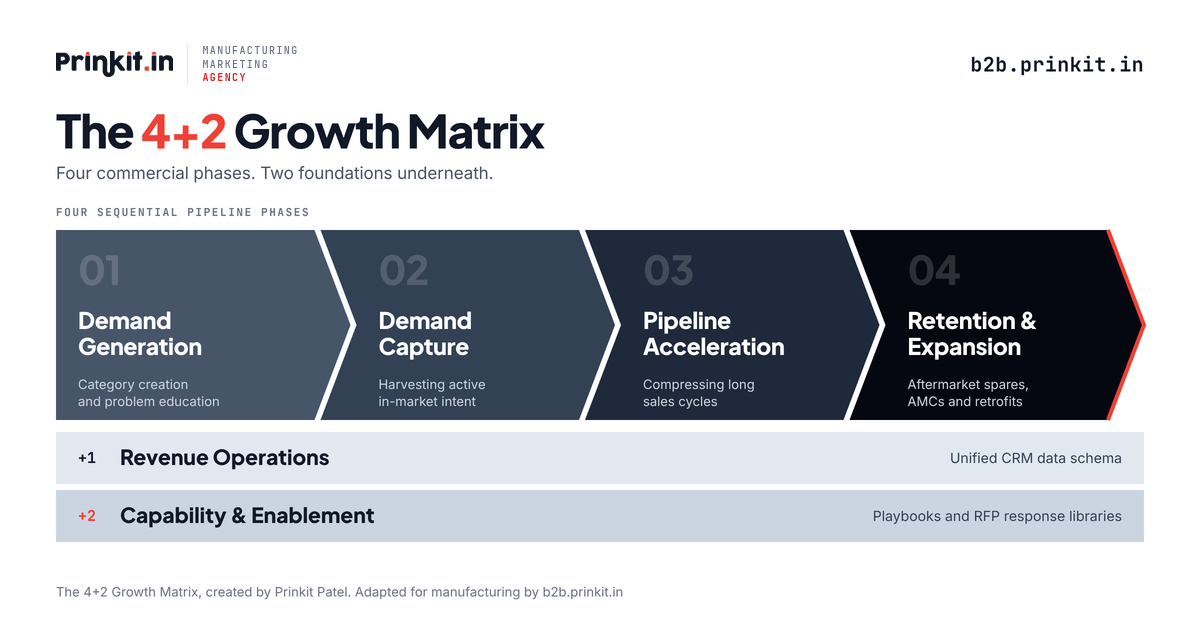
The 4+2 Growth Matrix is a commercial operating system created by Prinkit Patel for high-ticket, sales-led enterprise B2B organisations outside SaaS: it sorts every growth initiative into four sequential pipeline phases (Demand Generation, Demand Capture, Pipeline Acceleration, and Retention & Expansion) plus two cross-cutting foundations, Revenue Operations and Capability & Enablement.
Below, we explain the general framework first, then show how b2b.prinkit.in has adapted it for owners, MDs and sales and marketing heads at Indian capital-goods and engineered-to-order manufacturers.
The general framework
High-ticket, sales-led B2B organisations work under particular conditions: deals are large, sales cycles run for months, and each purchase is decided by a committee rather than one buyer. The 4+2 Growth Matrix gives these organisations a single structure for every growth initiative they might consider.
The structure is Mutually Exclusive and Collectively Exhaustive (MECE): every initiative belongs in exactly one place, and together those places cover the whole commercial journey.
The 4 are sequential pipeline phases, each with a primary owner:
- Demand Generation (marketing): creating the category and educating the market before an active buying cycle begins.
- Demand Capture (marketing): intercepting buyers already in the market and turning their intent into qualified opportunities.
- Pipeline Acceleration (sales): compressing long sales cycles and stopping proposals from stalling.
- Retention & Expansion (sales and customer success): growing the value of existing customers after the first order.
The +2 are cross-cutting foundations shared by every phase:
- Revenue Operations: the data, routing and attribution that let the phases run without leaks.
- Capability & Enablement: the governance, playbooks, collateral and skills that let marketing and sales execute together.
The framework is a menu, not a checklist. You diagnose where the pipeline leaks, weight the phases accordingly and choose a few focused plays.
Our adaptation for Indian manufacturers
Our version of the framework is adapted for Indian manufacturers by b2b.prinkit.in. We apply it to capital-goods and engineered-to-order businesses, where the economics are governed by one physical reality: plant capacity utilisation.
Fabrication bays, cranes, machining and test facilities carry fixed costs whether or not they are loaded, and specialist engineers, certified welders and estimators must be retained. When utilisation slips, unabsorbed overheads erode margins. Owners then face a structural vulnerability: word-of-mouth plateaus, public tenders force L1 price cuts, and large quotations freeze inside client review boards.
The component names stay the same. What changes is how each one is applied on and around the factory floor.
Demand Generation (Phase 1)
In heavy engineering, deals are often effectively decided at the Front-End Engineering Design (FEED) stage. If an engineering consultant standardises on a competitor's metallurgy or tolerances, you are left fighting an uphill L1 tender battle. Phase 1 embeds your technical authority in the engineering ecosystem before any RFP opens.
It has five sub-pillars:
- Algorithmic & Generative AI Discovery: content built around the engineering standards your buyers search for, structured so search engines and AI answer engines can recommend your plant.
- Proprietary Media & Category Thought Leadership: positioning your MD and technical leaders as practitioners with a clear point of view on reliability, metallurgy and capex.
- Targeted Cold Account Advertising & Paid Air-Cover: keeping your capabilities visible to buying-committee roles at a pre-selected list of target accounts.
- Third-Party Authority & Ecosystem Positioning: briefing programmes for the engineering consultancies that specify your equipment, plus signed technical articles in trade press.
- Community Cultivation & Educational Summits: closed-door roundtables and technical masterclasses for plant leaders, without commercial pitch pressure.
Demand Capture (Phase 2)
When a plant team receives capex sanction, it searches with exact duty specifications and code standards. Phase 2 gives those buyers a technically credible route to you and filters out brokers and low-value directory leads before they reach your estimators.
It has four sub-pillars:
- High-Intent Inbound Paid Search: bidding on parameter-specific searches and excluding low-ticket terms through negative keyword gating.
- High-Value Conversion Offers (HVCO) & Sizing Tools: sizing calculators, lifecycle payback models and editable specification templates in place of generic contact forms, so each enquiry arrives with much of the engineering data already captured.
- Conversion Path & Landing Architecture (CRO): specification-grade equipment pages with drawings and performance curves, direct scheduling with senior application engineers, and technical qualification gates before quotation.
- Targeted Commercial Field Marketing & Exhibitions: pre-booked meetings with identified project heads and private briefings around major exhibitions, instead of passive brochure distribution.
Pipeline Acceleration (Phase 3)
The biggest point of failure in capital-equipment sales often comes after the quotation is submitted: the technical team approves the machine, then the bid can wait in commercial review for months. Phase 3 equips your internal champion to carry the deal through the executive committee and defends margins against L1 price compression.
It has four sub-pillars:
- 1:1 & 1:Few Deal-Stage Account-Based Marketing (ABM): stage-triggered air-cover and private digital sales rooms holding the techno-commercial bid, test walkthrough videos and payback models in one secure place.
- Buying Committee Multi-Threading Kits & Toolkits: role-specific briefs for the CFO (cash flow and payback), the CPO (delivery, warranty and spares terms) and the Plant Head (reliability and maintainability), plus board approval decks and objective technical battlecards.
- High-Touch Relational & Executive Engagement: promoter-to-promoter sponsorship, on-site co-design workshops and peer reference conversations.
- Automated Deal Nurturing & Pipeline Reanimation: structured follow-up when proposals stall, re-engagement triggers such as an approaching plant shutdown, and closed-lost reviews.
Retention & Expansion (Phase 4)
In heavy machinery, the first equipment sale is only the beginning. Genuine spares, wear parts, overhauls and annual maintenance contracts (AMCs) carry strong margins, and local uncertified fabricators want that revenue. Phase 4 turns installed-base farming into a discipline.
It has four sub-pillars:
- Onboarding Excellence & Time-to-Value (TTFV): commissioning portals and 30-60-90 day performance audits confirming the machine delivers rated throughput.
- Installed Base Farming & White-Space Expansion: auditing historical shipments to forecast refurbishment and replacement cycles, and extending success at one plant to the client's sister units.
- Strategic Governance & Multi-Year AMCs: executive business reviews and structured service tiers that turn ad hoc maintenance into recurring revenue.
- Documentary Social Proof & Advocacy Engine: on-site video case studies and jointly authored technical papers that feed back into Phase 1.
Revenue Operations (+1)
Revenue Operations is the first foundation. It gives every phase unified quotation tracking, synchronised enquiry data, routing rules and multi-touch attribution, without software bloat. We advocate a stack-agnostic approach that works with the tools your team already uses, because a CRM that sales engineers abandon helps no one.
It has four sub-pillars:
- Commercial Tech Stack & Quotation Architecture: pipeline stages mapped to engineering reality, from FEED consultation and vendor pre-qualification through techno-commercial bid and buying board review to purchase order.
- Data Governance, Enrichment & Lead Scoring: enriching enquiries with company data and agreed scoring rules, so sales knows which accounts are in an active capex cycle.
- Routing SLAs, Territory Assignment & Speed-to-Lead: sending each enquiry to the right specialist and escalating anything left unacknowledged.
- Attribution, Velocity Cohorts & Forecasting Clarity: showing the MD where quotations stall and which early activity influenced an order closed months later.
Capability & Enablement (+2)
Capability & Enablement is the second foundation. Industrial buyers are sceptical of glossy brochures and want verifiable engineering proof. This foundation aligns marketing and sales, codifies how deals are qualified and turns shop-floor capability into evidence.
It has four sub-pillars:
- Commercial Alignment & Joint Revenue Council: a regular joint review of open quotes and pipeline by the MD, marketing and regional sales heads, with marketing attending customer technical reviews.
- Sales Methodology Codification (MEDDPICC): building qualification into the estimation workflow so engineers stop spending weeks on bids the company cannot win, and guiding reps to engage finance, procurement and operations.
- Centralised Collateral & Modular RFP Library: pre-approved certificates, test standards, compliance documents and standard clauses, organised by machine type, sector and buyer role.
- Skills Development & Shop-Floor Verifiable Proof: video records of hydrostatic testing, balancing and weld inspection, plus training engineers to present ROI and risk to client boards.
How we put the matrix to work
We never treat the 25 sub-pillars as a list to complete. We apply them in four steps:
- Diagnose Engine Leaks: find where quotation velocity stalls, whether from thin pre-RFP pipeline, weak enquiry conversion or proposals freezing in committee.
- Assign Strategic Weight: allocate leadership time and budget across the phases according to your plant's utilisation bottleneck.
- Select 2–3 Focused Plays: deploy a few initiatives aimed squarely at that friction point.
- Validate Enablement: confirm that Revenue Operations (+1) and Capability & Enablement (+2) are ready to support them.
To find where your own pipeline leaks, book our Free Manufacturing Growth Diagnostic: a 45-minute call with a senior consultant, plus a written report within 3 business days of the call. The full framework is on our 4+2 Growth Matrix page.
See also: putting the matrix to work in your marketing · B2B lead generation partner in India
Frequently asked questions
Who created the 4+2 Growth Matrix?
Prinkit Patel created it for high-ticket, sales-led enterprise B2B organisations outside SaaS. The version we use is adapted for Indian manufacturers by b2b.prinkit.in.
What do the 4 and the +2 stand for?
The 4 are sequential pipeline phases: Demand Generation, Demand Capture, Pipeline Acceleration, and Retention & Expansion. The +2 are cross-cutting foundations: Revenue Operations and Capability & Enablement.
Does it only work for engineered-to-order machinery?
No. Our adaptation is designed for engineered-to-order (ETO), configured-to-order (CTO) and standard industrial equipment. FEED-stage specification, committee decisions and plant capacity utilisation work the same way whether you make catalogue pumps or custom process plants.
Why invest in growth if our order book is full?
With sales cycles that run for months, the pipeline you build today determines plant loading in the quarters ahead. A full backlog without pre-tender relationships still leaves your bays exposed to capex downcycles and project delays.
How does the matrix help us avoid L1 price wars?
L1 auctions happen when a manufacturer enters the buying cycle after the tender specification is fixed. Demand Generation gets your engineering parameters into the specification early, and Pipeline Acceleration gives the CFO a total-cost-of-ownership case, so low-cost uncertified bids struggle to comply.
Score your commercial engine in 15 pages
Six self-checks, a one-page scorecard and a four-step plan, built for Indian manufacturers.
Download the 4+2 PlaybookThe 4+2 Growth Matrix, created by Prinkit Patel. Adapted for manufacturing by b2b.prinkit.in