
How should a B2B company position its trade show booth to maximise commercial demand capture?
High-converting trade show booths avoid generic corporate slogans and implement four precise positioning disciplines: (1) The 3-Second Hook that declares one uncontested core competence; (2) Macro-Bottleneck Alignment that frames equipment around the buyer's cost or regulatory constraint; (3) Direct Risk De-escalation that guarantees zero defect/downtime; and (4) Digital Demand Capture that converts physical booth visits into multi-stakeholder CRM pipelines within 4 hours.
- Radical Specialisation: DISCO wins by highlighting three Japanese words (Kiru, Kezuru, Migaku: Cut, Grind, Polish) instead of claiming to be a "full-service engineering provider."
- Problem-First Copy: Ovivo and Nalco Water hook fab buyers with "More AI Chips. Less Water" rather than listing reverse osmosis technical specifications.
- Zero Compromise on Quality: CECO Environmental anchors its clean air systems on catastrophic contamination prevention.
- Digital Bridge: Eliminating paper brochures and replacing them with dynamic QR codes that link to Digital Engineering Dossiers and DFM feasibility portals.
1. Why do traditional expo stalls fail to win orders?
Most stalls spend on floor space, brochures and travel, then collect business cards in a fishbowl. By Monday, most cards are unqualified, the few genuine leads get a generic email with a brochure attached, and the plant head or sourcing VP has already forgotten the stall. The result is zero closed deals to justify the spend.
If you walk down the aisles of IMTEX, ELECRAMA, ChemTECH, or SEMICON India, you will witness the exact same commercial tragedy repeated across most exhibition stalls:
A precision engineering firm or machinery manufacturer spends a sizeable budget on floor space and booth fabrication. They fly out a team of sales engineers and senior directors. They print hundreds of glossy multi-page product brochures. And right at the reception counter sits an acrylic fishbowl, flanked by plates of mints, waiting for passersby to drop their business cards.
By the close of the final day, the team celebrates having collected a stack of business cards. But when Monday comes:
- Most cards are unqualified: Students, competitors, real estate brokers, and catalogue collectors.
- The few genuine leads receive a generic email: *"Dear Sir, It was a pleasure meeting you at our stall. Attached is our company brochure."*
- Zero pipeline conversion: The Plant Head or Sourcing VP has already forgotten who you were, leaving you with zero closed deals to justify a significant expenditure.
- Header text: "Leading Provider of Complete Industrial Solutions"
- Standees packed with dozens of small bullet points of machine specs
- Handing out thick physical catalogues that get discarded in hotels
- Collecting paper business cards in a glass fishbowl
- Sales reps sitting behind counters checking laptops
- Post-expo follow-up: Generic PDF blast days later
- Header text: 3-second hook addressing a single critical bottleneck
- Large high-contrast value proposition visible from across the aisle
- Digital Vendor Dossier accessed via mobile-optimised QR code
- Pre-booked private executive briefings locked before Day 1
- Interactive tactile/visual proof that forces aisle dwell time
- Post-expo follow-up: Stakeholder-specific DFM portal within 4 hours
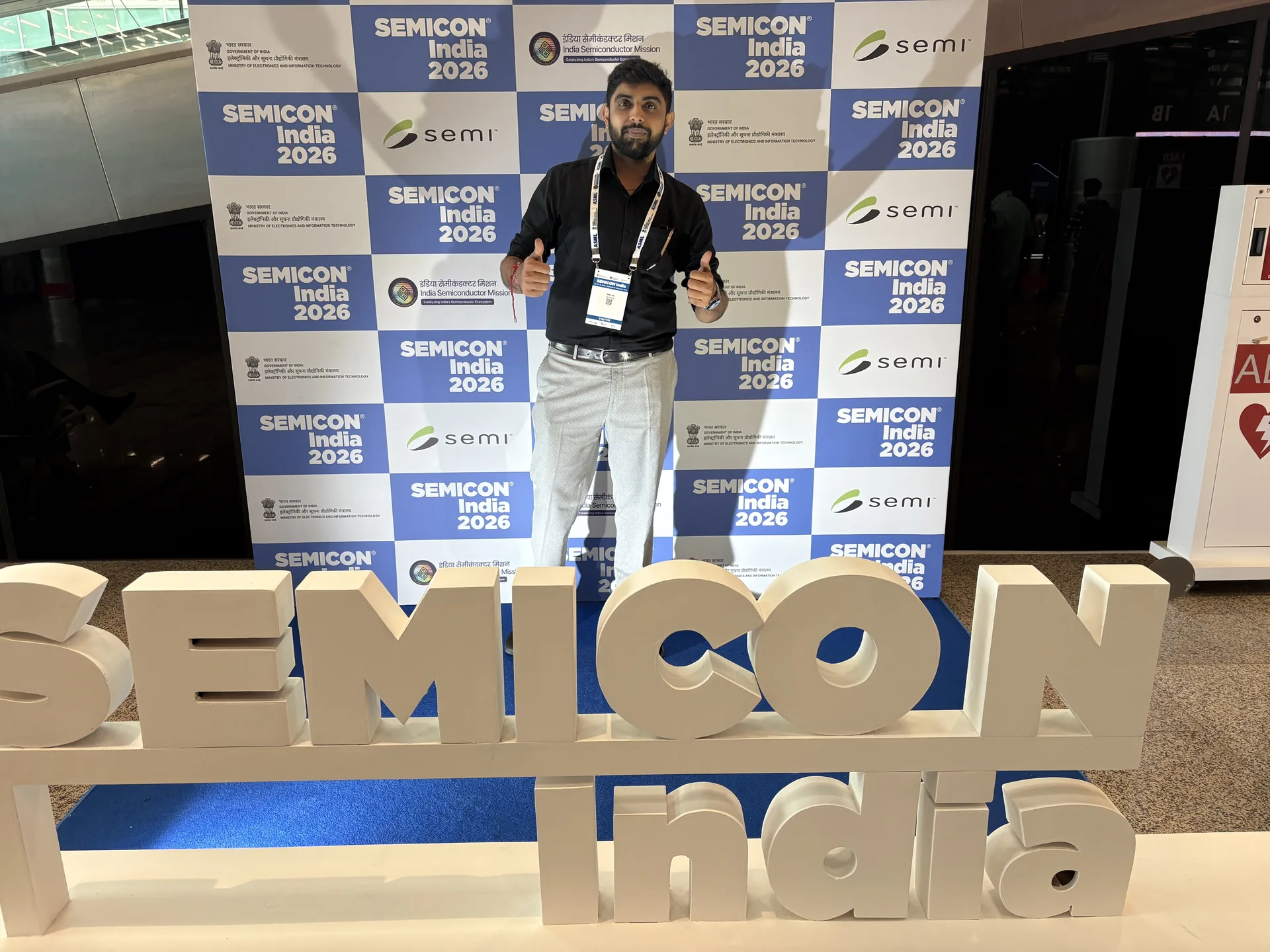
2. The 3-Second Rule: Why DISCO’s "Cut, Grind, Polish" Out-Converts "One-Stop Solutions"
In high-speed exhibition environments, an attendee decides almost instantly whether to slow down or keep walking. If your stall fascia says: "An ISO 9001:2015 Certified Manufacturer of World-Class Precision Components," the buyer's brain processes it as background noise. It conveys zero differentiation.
Now observe how DISCO Corporation—the undisputed global titan of semiconductor wafer thinning and separation—approaches booth architecture:
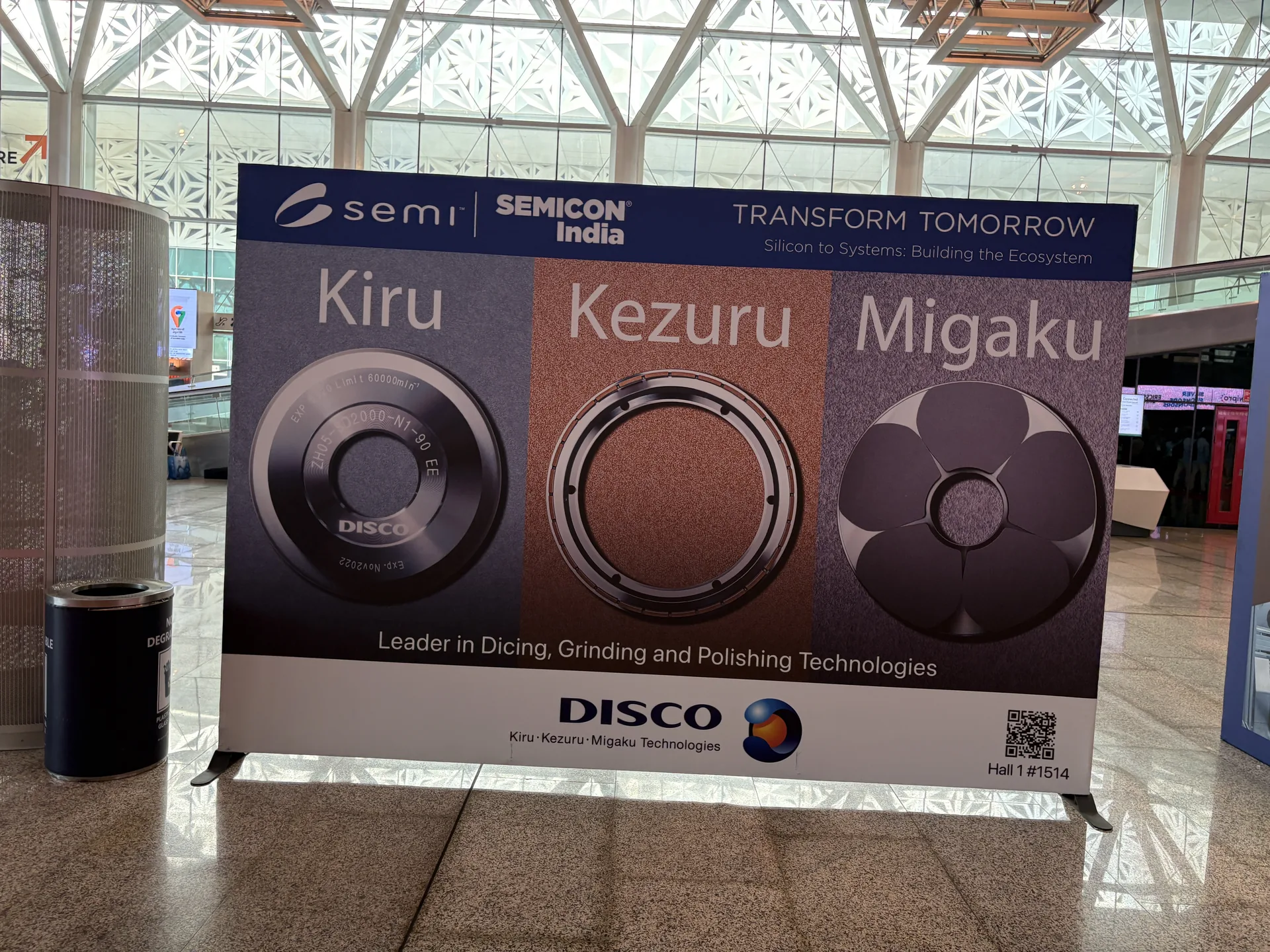
DISCO does not claim to make wafer cleaners, inspection cameras, or robotics—even though their equipment contains all three. They stake their global reputation on three verbs: Cut, Grind, Polish.
The Actionable Fix for Your Next Expo: Strip most of your product catalogue off your booth banners. If you manufacture hydraulic presses, don't write: "Total Industrial Solutions for Automotive, Aerospace, and General Engineering." Write: "500-Ton High-Speed Forging Presses: Zero Cycle Time Drift at 220 SPM." Own a single technical reality.
3. Tying Positioning to Macro Bottlenecks: Ovivo & Nalco Water’s "More AI Chips. Less Water."
One of the costliest errors in B2B trade show marketing is Feature-Led Signage. Engineers love listing specifications: pump RPM, flow rates, filtration microns, and metallurgy grades. But executive buyers (Operations Directors, CFOs, ESG Officers) do not buy specifications; they buy solutions to acute operational bottlenecks.
Consider the collaboration booth between OVIVO and NALCO Water (An Ecolab Company):
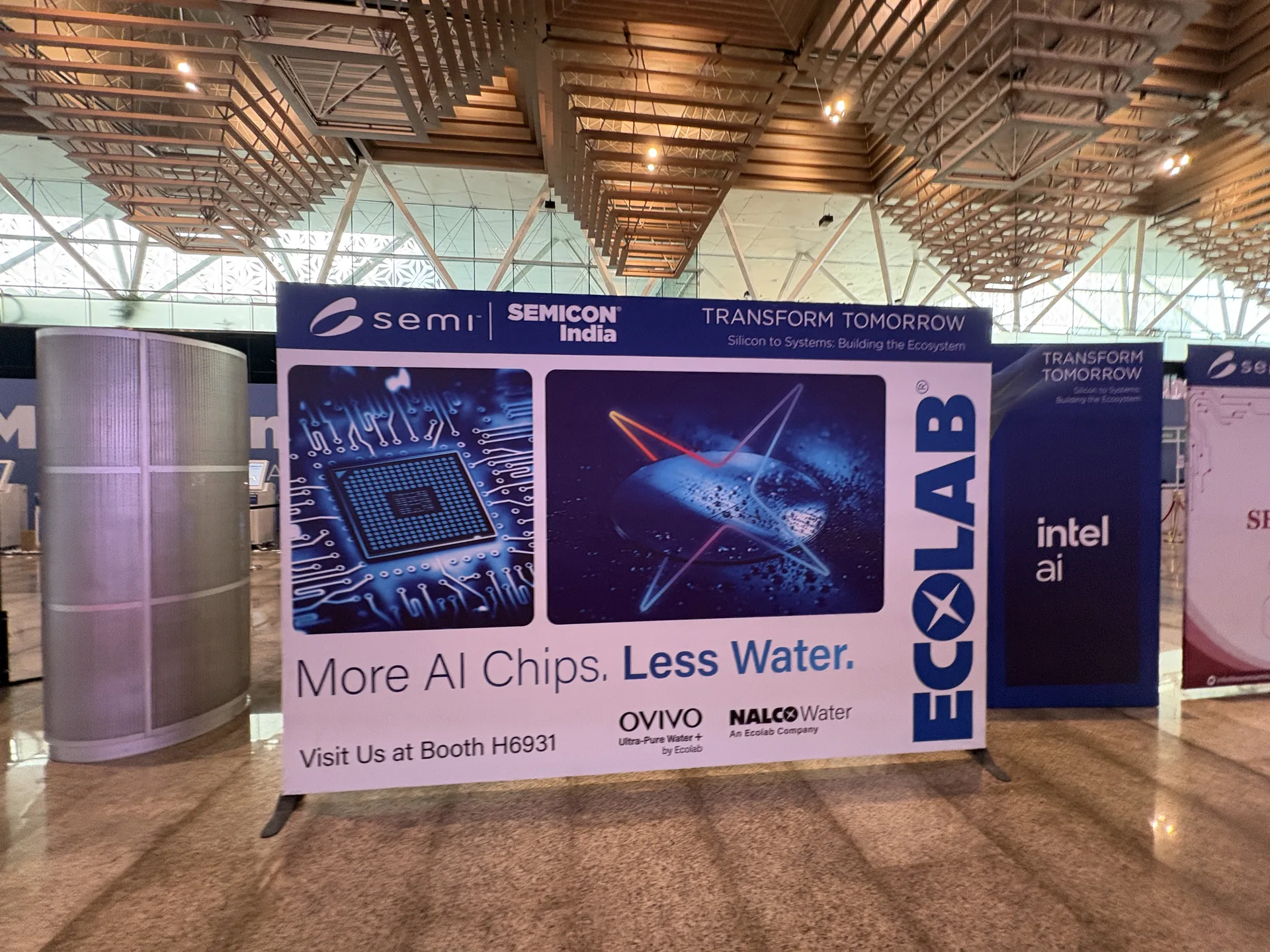
Why is this headline pure demand capture genius?
- It links directly to the macro AI boom: Everyone at SEMICON India is talking about AI GPUs. AI chips require massive, highly complex fab steps.
- It addresses the dark reality of chip manufacturing: A single commercial wafer fab consumes enormous volumes of Ultra-Pure Water (UPW) every day. In water-constrained regions like Gujarat or Tamil Nadu, water permits dictate factory licensing.
- It creates an executive value proposition: It promises increased manufacturing output (More Chips) while solving regulatory and environmental constraints (Less Water).
4. Why should expo messaging focus on the buyer’s risk?
Because industrial purchases carry career risk. If a manager picks a cheaper new vendor whose equipment causes a contamination shutdown, that manager’s job is on the line, so buyers buy to avoid failure. CECO Environmental’s “Clean Air. Critical Process. Zero Compromise.” shows the approach: reassure project managers that choosing your equipment carries zero operational risk.
B2B industrial purchases are defined by asymmetric career risk. If a procurement manager selects a new vendor who saves a little on price but causes a plant shutdown due to particulate contamination, that manager’s job is on the line. In high-stakes manufacturing, buyers buy to avoid catastrophic failure.
Notice how CECO Environmental designed their messaging:
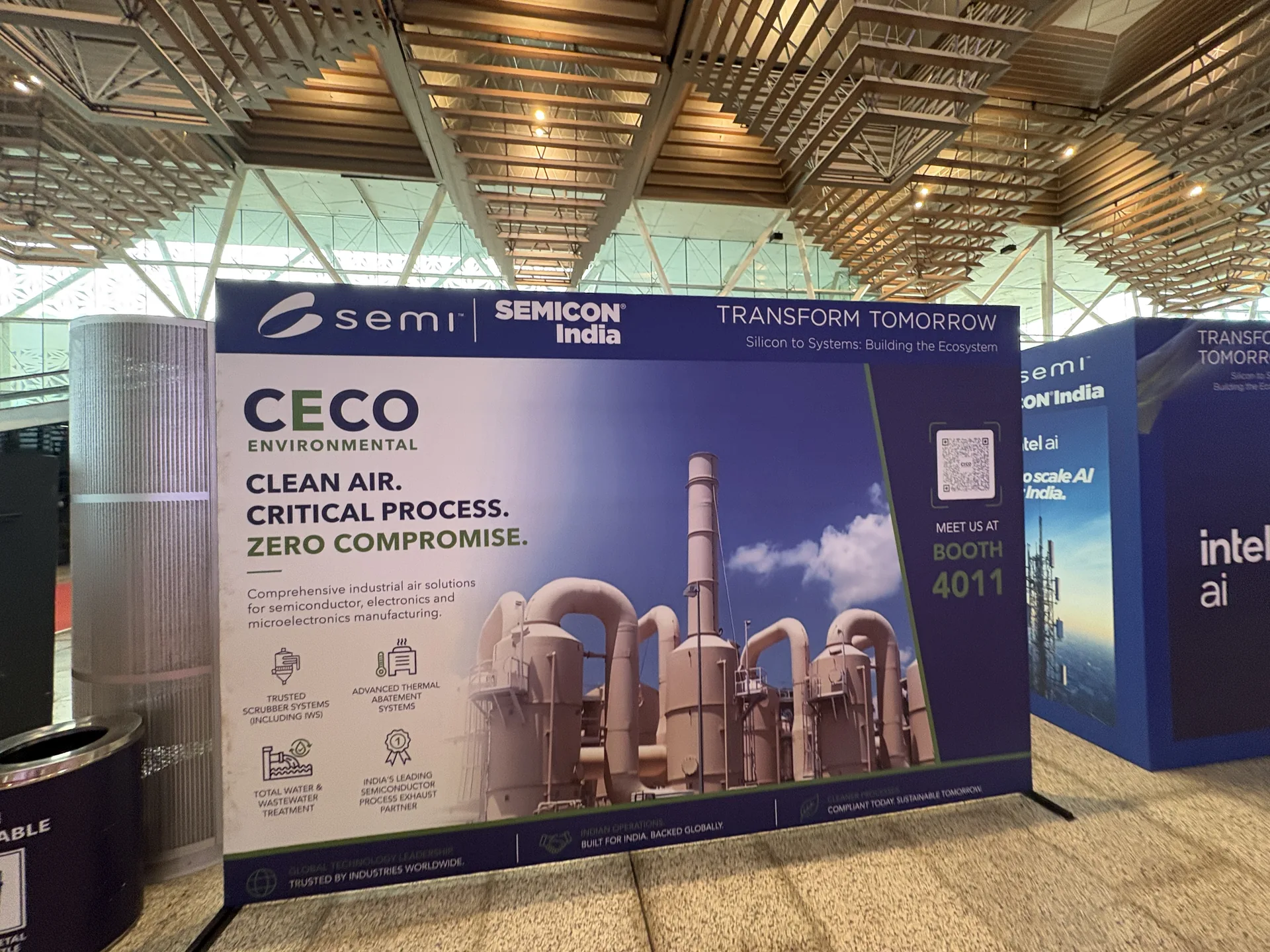
If you sell industrial scrubbers, valves, blowers, or air handling units, stop competing on raw price per unit. Your expo messaging must reassure Tier-1 project managers that choosing your equipment carries zero operational risk:
- ❌ "Affordable Heavy-Duty Industrial Exhaust Fans"
- ✅ "ISO Class-1 Cleanroom Exhaust Systems: Guaranteed Zero Downtime and Sub-PPM Molecular Scrubbing"
5. Category Elevation & Pricing Power: Tokyo Electron’s "Atoms to AI"
When your company is perceived as a commodity machinery supplier, procurement teams will relentlessly squeeze your margins. To unlock pricing power, global primes elevate their brand stature from "machine builder" to enabler of the future.
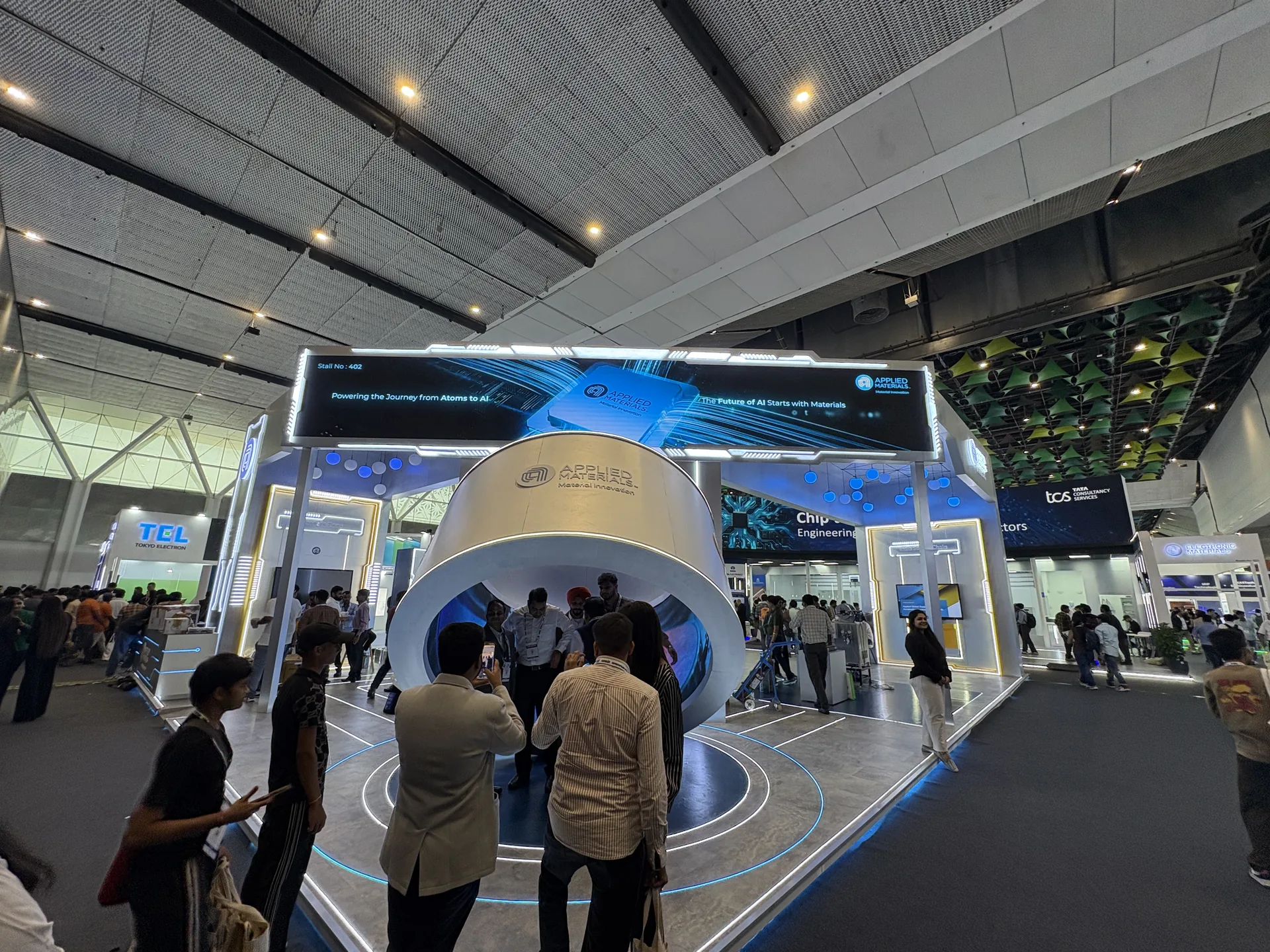
Tokyo Electron does not sell "etching and coater-developer tools." They frame their business as the bridge between quantum atomic physics and artificial intelligence. When an engineering prime positions at this level, enterprise customers do not commoditise their quotes.
6. Repositioning Legacy Capabilities: Resonac’s Advanced Packaging Shift
Many Indian industrial manufacturers say: "We are an established casting / machining / chemical company. How can we present ourselves to modern high-growth industries like semiconductors, EVs, or aerospace?"
Look at RESONAC (formed by the merger of Showa Denko and Hitachi Chemical):
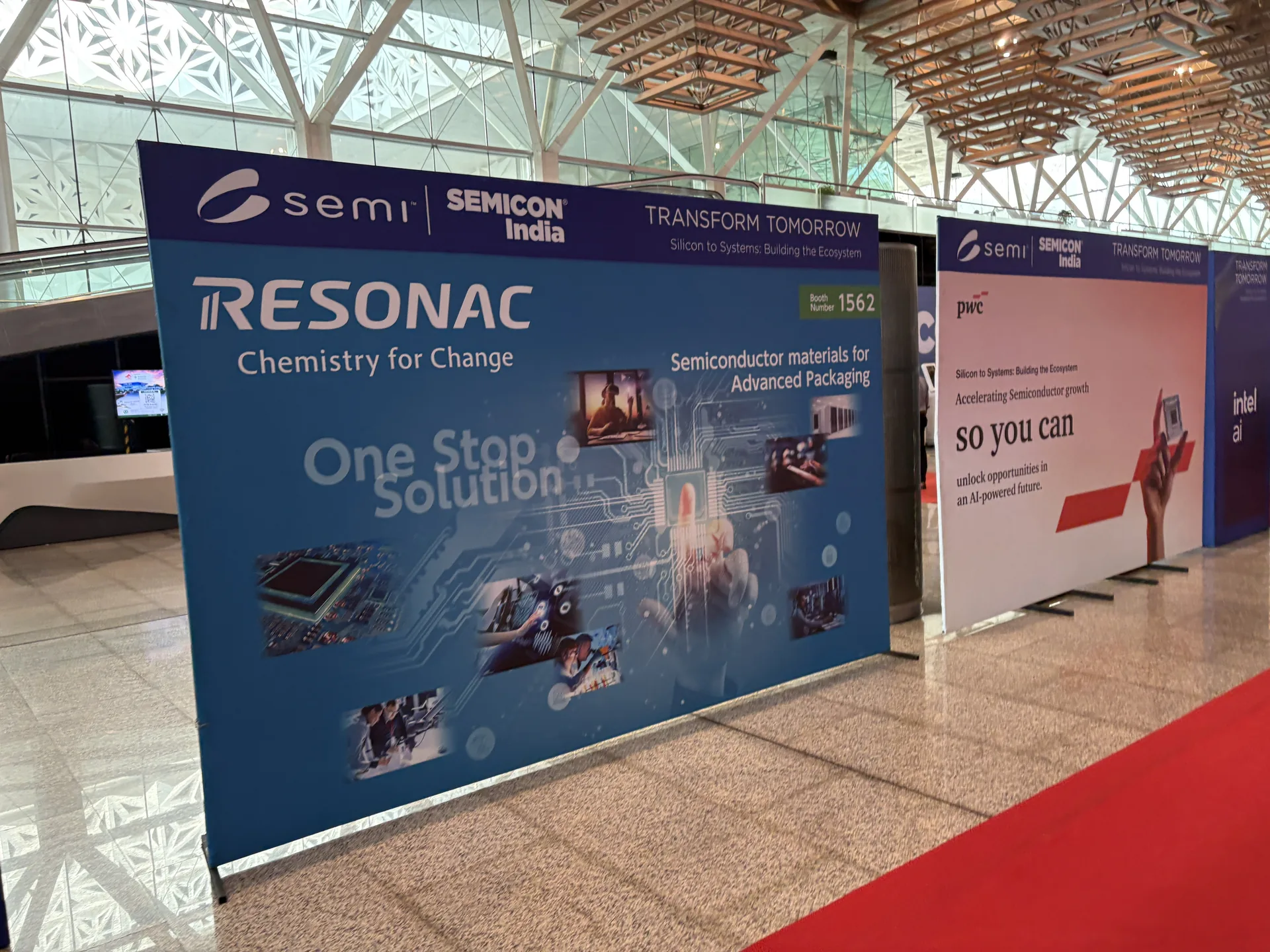
Resonac didn't display general industrial resins or basic polymers. They anchored their presence on Advanced Packaging—the precise segment driving 2.5D/3D chiplet integration for Tata Electronics, Micron, and global OSATs.
7. The Interactive Traffic Stopper: Stopping Aisle Foot Traffic Cold
Attendees cover long distances on foot every day across vast exhibition halls. Their senses are overwhelmed. Static standees with blocks of text are ignored.
To stop attendees, you need an Interactive Curiosity Anchor. The SEMICON India exhibition floor demonstrated this with a tactile, high-contrast infographic wall:
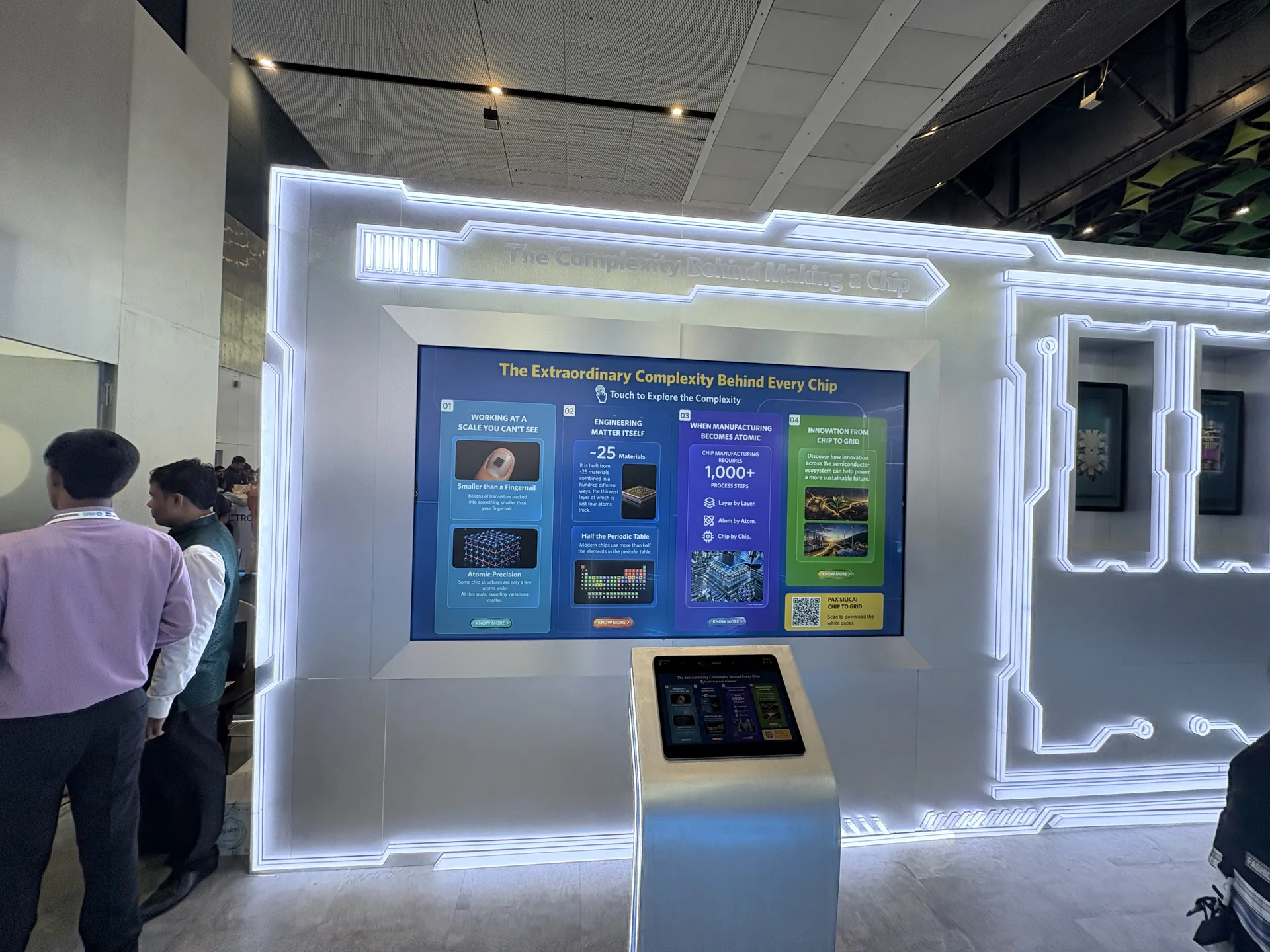
Every high-converting trade show booth needs one visual or physical anchor that makes an engineer stop and point their phone:
- Transparent acrylic cutaway: Showing internal planetary gears or fluid turbulence.
- Extreme comparison samples: A micro-machined titanium nozzle next to a conventional drilled part under a magnifying glass.
- Real-time interactive touchscreen calculator: Calculating plant idle capacity cost or power consumption savings in seconds.
8. How do you turn expo footfall into pipeline?
Run the event in four phases of the 4+2 Growth Matrix. Pre-book private briefings with verified plant heads and procurement directors four weeks ahead. Replace paper brochures with QR codes that open a Digital Vendor Dossier. Send a personalised engineering brief the same evening a badge is scanned. Then retarget finance, quality and operations until they agree.
Great booth design and sharp copy stop attendees. But Demand Capture is what turns that attention into bankable revenue.
Under the 4+2 Growth Matrix for Capital Goods, event participation is engineered across four chronological phases:
Never rely on walk-in traffic. 4 weeks prior to the expo, run account-based digital campaigns targeting verified Plant Heads & Procurement Directors in the host city, pre-booking private booth briefings.
Replace paper brochures with dynamic QR badges. When a prospect scans the code, they unlock a tailored Digital Vendor Dossier containing CAD files, DFM feasibility checklists, and compliance certificates.
Leads go cold fast. When a visitor's badge is scanned, an automated, personalised engineering brief is delivered to their inbox that same evening—complete with meeting notes and technical references.
Industrial machinery decisions require approval from Finance, Quality, and Operations. Deploy account-based retargeting to surround every decision-maker with case studies and ROI proofs.
| Element | The Traditional High-Cost Expo Approach | The 4+2 Growth Matrix Demand Capture Engine |
|---|---|---|
| Booth Hook | "Complete Engineering Solutions" | Sharp 3-Second Core Competence (e.g. DISCO's "Cut, Grind, Polish") |
| Copy Focus | Technical equipment specs and machine dimensions | Macro-problem alignment (e.g. Ovivo's "More AI Chips, Less Water") |
| Collateral | Hundreds of printed catalogues (most discarded in hotels) | Gated Digital Engineering Dossier with instant CAD/DFM access |
| Lead Capture | Business cards dropped in an acrylic fishbowl | Verified mobile QR capture with immediate technical qualification |
| Follow-Up Speed | Days or weeks post-event via generic email blast | Within 4 hours: Automated stakeholder brief with custom video walkthrough |
| Primary Metric | "Footfall and number of cards collected" | Total Pipeline Value (₹ Crores) & Qualified RFQs generated |
Ready to Stop Wasting Money on Passive Trade Show Stalls?
Whether you are preparing for SEMICON India, IMTEX, ELECRAMA, or international industrial trade fairs, learn how to turn your exhibition footprint into an engineered pipeline generator.
Frequently Asked Questions on Trade Show Demand Capture
Critical answers for B2B engineering promoters, sales vice presidents, and marketing directors looking to maximise industrial exhibition ROI.
What is B2B Expo Demand Capture?
B2B Expo Demand Capture is an engineered commercial methodology that replaces passive trade show booth attendance with systematic pipeline generation. Rather than collecting random business cards and distributing paper brochures, it combines a sharp 3-second hook, pain-focused stall signage, mobile QR-enabled Digital Vendor Dossiers, and pre-scheduled VIP stakeholder briefings to convert physical footfall into qualified RFQs within 4 hours.
Why do most industrial trade show stalls fail to generate high-ticket machinery orders?
Most B2B manufacturers fall into "The Fishbowl Trap." They spend real money on booth fabrication, print hundreds of product catalogues, collect random business cards in a glass bowl, and wait passively for visitors. Most stall visitors are unqualified brochure collectors, and without immediate multi-stakeholder digital nurture, leads go cold within days.
What is the 3-Second Rule in trade show booth messaging?
The 3-Second Rule dictates that an attendee walking down an exhibition hall aisle must instantly comprehend what you do, who it is for, and the primary business outcome within three seconds. Global primes like DISCO achieve this with radical clarity ("Kiru, Kezuru, Migaku: Leader in Dicing, Grinding, and Polishing"), whereas failed stalls use meaningless jargon like "Comprehensive Engineering Excellence."
How does Ovivo & Nalco Water position industrial utilities for semiconductor fabs?
Instead of pitching technical equipment specs like reverse osmosis pumps or ion-exchange resin filters, Ovivo and Nalco Water hook buyers with the high-stakes macro problem: "More AI Chips. Less Water." This immediately aligns with C-suite capital expenditure priorities and ESG regulatory constraints.
How can Indian Capital Goods OEMs connect physical expo stalls to digital pipeline?
Indian OEMs should eliminate paper brochures and deploy dynamic QR codes leading to gated Digital Engineering Dossiers, interactive plant capacity calculators, and instant DFM (Design for Manufacturability) feasibility portals. This captures verified contact details of Plant Heads and Procurement Directors for automated follow-up within 4 hours.
How much should a B2B capital goods company spend on digital vs. physical stall fabrication?
Most OEMs commit almost all of their event budget to stall fabrication and next to nothing to demand generation. Best practice under the 4+2 Growth Matrix allocates the larger share to physical booth space and clean modular fabrication, and a meaningful share to pre-event account-based targeting, VIP meeting acquisition, dynamic digital collateral, and multi-stakeholder post-event nurture.
Why is radical specialisation more effective than pitching "one-stop solutions" at industrial expos?
Specialised buyers from Tier-1 conglomerates (Tata Electronics, L&T, Bharat Forge) visit trade shows looking to solve specific engineering bottlenecks. A company claiming to do "everything" is assumed to be mediocre at all of it. Declaring extreme competence in one core domain immediately establishes credibility and commands premium pricing.
What is a Digital Vendor Dossier?
A Digital Vendor Dossier is a secure, cloud-hosted executive document hub created specifically for high-intent buyers. Accessed via a mobile QR scan at your booth, it provides immediate access to machine tolerance charts, ISO/AS9100 quality certifications, customer video case studies, and a direct DFM submission tool—eliminating the need for heavy paper catalogues.
Score your commercial engine in 15 pages
Six self-checks, a one-page scorecard and a four-step plan, built for Indian manufacturers.
Download the 4+2 Playbook